In the spring of 1999, Dr. Nicholas Crawford persuaded his fellow board members at Friends of the Lost River to build a dam inside a cave. Crawford directed WKU's Center for Cave and Karst Studies and served on the nonprofit's board. The dam was meant to make float tours through the cave possible, and Crawford wanted those tours because they would bring in money for conservation. The park's own history describes his reasoning as "if we build it they will come."
That dam is the reason a Bowling Green resident can walk two miles of trail off Nashville Road without paying anything. The boat tour was built to fund the rest of the park, and together with the gift shop and other visitor income it still pays for most of it.
The ticket and the trail share one budget
Lost River Cave is run by Friends of the Lost River, Inc., a 501(c)(3) incorporated in 1990. The original 25-acre valley belongs to Western Kentucky University, and the nonprofit has bought adjoining parcels since then. The park's mission page says boat tour proceeds and other tourism income provide "the majority of financial support" for a 72-acre park that is "open year-round and free to the public."
Here is what that money covers. The park protects the cave, the woodland valley and its blue holes, and more than two miles of natural and paved trail. It is also restoring a 20-acre Barrens Prairie along Dishman Lane and maintaining a constructed wetland, where native plants keep stormwater runoff out of the cave system. The organization also pays mortgages on three parcels of land, which the mission page calls its only long-term debt.
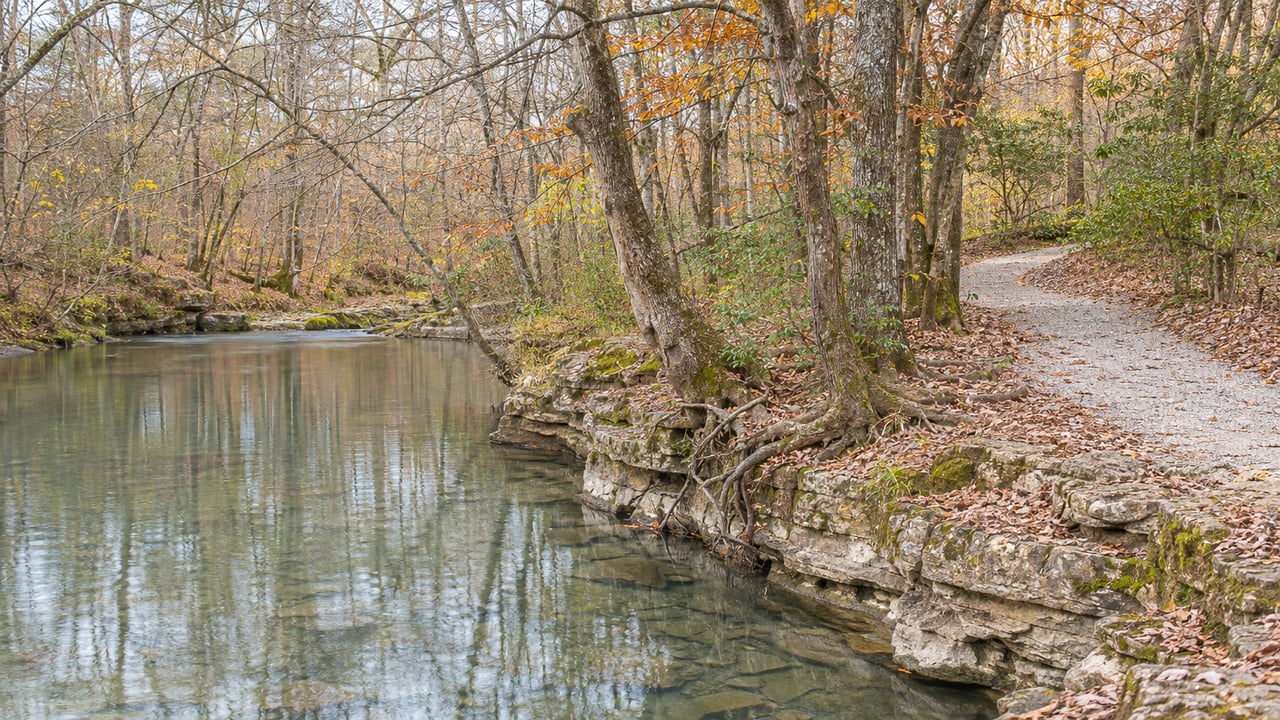
The free side of the park is open from sunrise to sunset all year. The Blue Hole Trail passes blue holes, limestone bluffs and a natural spring. It also passes the remains of powder houses that held the dynamite used to quarry limestone from the valley during the Civil War. Above the valley, the paved Prairie Greenways Trail runs past the prairie restoration and welcomes walkers, runners, strollers and leashed dogs.
The paid side is the Cave Boat Tour. Tickets cost $23.95 for adults 13 and older, $16.95 for ages 4 to 12, and $5.95 for children 3 and under. The tour lasts 45 minutes, starting with a 20-minute guided walk down a sloped path along the river and ending with a 25-minute boat ride through the cave. The gift shop is part of the same budget. Lost River Cave says 100% of gift shop proceeds go back into the park and help keep the trails free.
Before the boats, a dance floor
The idea that the cave could pay its own way goes back further than 1999. In the 1930s, W.L. Perkins built an underground nightclub at the mouth of the cave. His great-nephew, Harold Perkins Smith, told the Bowling Green Daily News in 2002 that people came because "there wasn't air conditioning hardly, and it was cool down there." Smith remembered a filling station, a restaurant and cabins on the bluff. He grew up in the Nashville Road brick home that is now the park's gift shop and visitor center. The Daily News called the club the Underground Nite Club in the 1930s and 1940s.
The club's best years came after World War II. WBKO's 2017 report calls it the Cavern Nite Club, with Jimmie Stewart at the center of its postwar run. The report says it operated from the 1930s until the late 1950s. Rho Lansden, then the park's executive director, told WBKO it was a place where "your best beau took you down the stairs, clinging to the edge of the bluff, for a night of good times with your friends."
According to the Daily News, tourist business at Lost River continued through 1972, and from then until 1990 trespassers littered the valley. Recovery started in 1986, when the owners donated the cave entrance and 25-acre wooded valley to WKU. The donors were WKU professor Dr. Raymond Cravens, WKU Physical Plant Administrator Owen Lawson, and Mr. and Mrs. Leroy Highbaugh. In 2001, commercial development threatened the land next to the valley. The Friends group bought another 42 acres with support from the City Commission and the Greenways Commission of Bowling Green and Warren County, and later purchases brought the park to its current 72 acres.
The boat tour still tells the older stories, presenting the cave as a Native American hunting ground, a Civil War campground and a hideout for Jesse James. The Civil War part is on firmer ground: a historical marker records Union and Confederate encampments near the cave. The Jesse James story is still legend. A 1976 WKU student report said it had never been verified, even though the hideout was widely advertised.
What happens when the boats stop
In April 2025, the funding model was tested. The Daily News reported that heavy rain over several days dropped just over 10 inches on Warren County. CEO Justin Jennings said water at the mouth of the cave rose about 60 feet above normal, most valley trails flooded, and tours were paused.
Jennings explained the problem in the same Daily News article: "When our boat tours aren't running, we're not bringing in revenue." The flood came during spring break, which he called prime season. Early estimates put repairs at $15,000 to $20,000, much of it payroll. A four-day flash fundraiser raised nearly $7,000 for cleanup. The butterfly habitat was one of the only places in the park the water didn't reach, because it sits on higher ground.
The flood also showed how this valley works. The river under Lost River Cave is part of Bowling Green's karst drainage. That is the same system behind the sinkhole question on local disclosure forms, and it is the reason the park maintains a wetland to filter runoff before it reaches the cave.
What 2026 added above ground
The park's biggest additions this year are on the free side. Construction began January 7 on an 1,800-square-foot pavilion behind the gift shop near the wetland. The Daily News reported that fundraising for it went back to 2018 and that a gift from longtime supporters Valerie Brown and Ken Kuehn moved it forward. The Nature Discovery Pavilion was dedicated on Monday, September 14, and the first group of students used it that day. Katie Cielinski, executive director of philanthropy, told WBKO that the park had taught some field trips "on the sidewalk" and "under the sun" before the pavilion was built. She called the new space "literally our common ground."
On March 14, the Daily News photographed researchers from WKU's Crawford Hydrology Lab pouring eco-friendly fluorescent dye into the river for St. Patrick's Day. They showed visitors how dye tracing follows underground flow and where pollutants could travel. Part of the demonstration took place at Blue Hole 3, a karst window where the underground river comes to the surface.
In October, the 15th Scarecrow Trail filled about a mile of trail with nearly 90 community-made displays, and the walk was free, according to WBKO. Next spring, a new Discovery Fund starts with a $25,000 founding gift from General Motors. It will pay up to $15 per student toward field trips for eligible Title I schools within 80 miles.
Thanksgiving week at the cave
The cave stays at 57 degrees all year, and the park suggests a light jacket. The temperature that brought dancers in during the 1930s makes the cave an easy outing for visiting family in late November. As of mid-November, the park's online booking calendar showed boat tours available every day of Thanksgiving week except Thanksgiving Day itself, Thursday, November 26. Tours were also open Friday through Monday, November 27 to 30. The park is also closed on Christmas Eve, Christmas Day and New Year's Day.
Before you bring guests, the FAQ has a few planning notes. Plan to arrive 30 minutes to an hour before your tour. Walk-in tickets are sold first come, first served, and reservations are strongly recommended. The tour is not handicap accessible because of the cave's natural features. In the off-season, groups of 25 or more can book at a discount, which covers a big family gathering. If the tour sells out, the trails are still open and free.
On Wednesday, December 2, the gift shop holds its Merry & Bright Shopping Night from 3 to 7 p.m. The water wheel will be lit at 5:30 p.m., and Flake, the park's white squirrel mascot, will pose for photos on the porch. Members get 20% off their purchases that night. A full-year membership costs $40 a year, and monthly levels run from $10 to $100. Lost River is also part of the trail network we covered in our post on Warren County's trails.
At Jeremy Dawson Realtor Group, we keep track of the places that give Bowling Green its value, and Lost River Cave is one we point people to every season. If you're hosting family this week and wondering what your own home is worth in today's market, get your instant home valuation.